Presentación
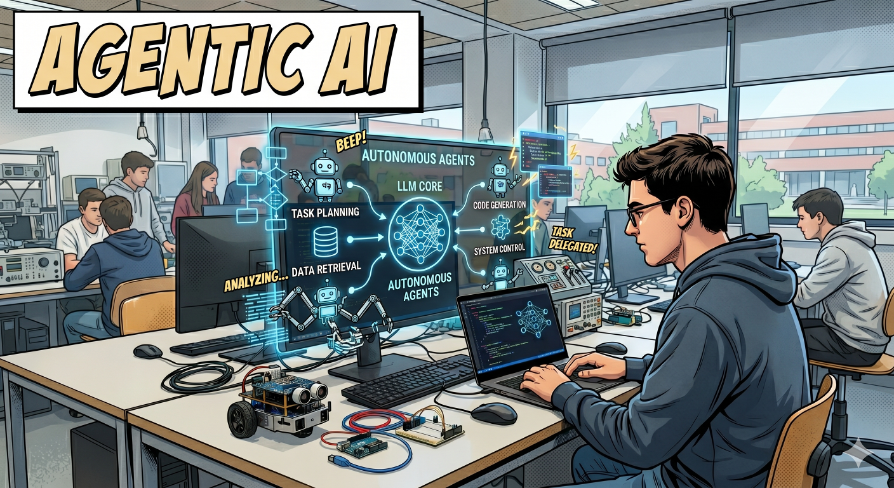
Autonomous AI agents represent one of the most impactful frontiers in modern artificial intelligence. This technically-oriented course introduces participants to the design and implementation of AI agent systems, from simple tool-using agents to sophisticated multi-agent research pipelines. Using the LangChain and LangGraph frameworks in Python, students will build working agents step by step, gaining hands-on experience with the concepts and engineering patterns that underpin real-world agentic systems. The course bridges current academic research in large language models with practical software development, equipping participants to design and deploy autonomous agent workflows.
Objetivos
By the end of the course, participants should be able to:
- Explain what an AI agent is and how it differs from a standard language model interaction
- Design and implement custom tools using the LangChain
- Model agent workflows as state graphs using LangGraph
- Apply prompt engineering techniques to guide agent behaviour reliably
- Build a multi-agent system with a supervisor coordinating parallel sub-agents
- Assemble a complete end-to-end research pipeline from user input to final report
Destinatarios y requisitos
- This free course has a technical focus and is aimed at students or graduates in computer science, engineering, or related disciplines, as well as professionals with programming experience who want to understand how modern AI agent systems are built.
- Basic Python programming knowledge is required. Prior experience with machine learning or large language models is helpful but not essential.
- Participants need to bring their own laptop with an active GitHub account set.
Duración y modalidad
8 hours of instruction distributed across two sessions, combining live coding, guided exercises, and hands-on implementation.
Fechas y lugar de impartición
- Session 1 — Monday, 22 June 2026, from 16:00 to 20:00
- Session 2 — Tuesday, 23 June 2026, from 16:00 to 20:00
The course will be held at the EI Informática / ETSI de Telecomunicación, Universidad de Valladolid (Sala Hedy Lamarr).
Imparte
Hichem Saoudi. Software Engineer and AI researcher currently pursuing a PhD at the University of Valladolid. Specialized in computer vision and large language models, with experience as a deep learning teaching assistant. Focused on bridging advanced academic research with practical software engineering to build autonomous agent workflows.
Jordi Pozo. Computer Engineer specialized in Artificial Intelligence, currently pursuing a PhD in AI and Computer Vision at the University of Valladolid.
Vocational Education teacher in Computer Science and AI & Big Data, focused on applied AI, software development, and digital innovation.
Organiza
Centro de Inteligencia Artificial de la Universidad de Valladolid (UVaIA), Ayuntamiento de Valladolid, Agencia de Innovación y Desarrollo Económico (Ideva), Vicerrectorado de Innovación Docente y Transformación Digital de la Universidad de Valladolid y Centro VirtUVa.
Programa
Session 1 — Agent Fundamentals (22 June, 16:00–20:00)
- Simple Agents with LangChain
- What is an AI agent and how tools work
- Building a calculator, web search, and custom tools
- Hands-on exercise: implementing a country-info tool
2. Graph-Based Agents with LangGraph
- Nodes, edges, and state: the LangGraph mental model
- Building and visualising a conversational chatbot as a state graph
3. Scoping: User Clarification and Research Brief Generation
- Gathering user context through targeted clarification
- Structured output schemas and dynamic control flow
Session 2 — Multi-Agent Research System (23 June, 16:00–20:00)
4. The Research Agent
- Prompt engineering techniques to guide agent behaviour
- The LLM Decision → Tool Execution → Compression loop
5. The Research Supervisor
- Supervisor and sub-agent architecture with isolated context windows
- Task decomposition: when to use one agent vs. many in parallel
6. Full Multi-Agent Research System
- Integrating all components into a single end-to-end pipeline
- Running a complete workflow: from user question to final report
Este curso se integra dentro de un paquete formativo impulsado desde el Centro de Inteligencia Artificial de la Universidad de Valladolid (UVaIA) en colaboración con el Ayuntamiento de Valladolid, a través de la Agencia de Innovación y Desarrollo Económico (IdeVA), el Vicerrectorado de Investigación de la Universidad de Valladolid y el Centro Virtuva.
El centro UVaIA se estrenó en mayo de 2024 integrado por expertos de diferentes áreas de la Universidad de Valladolid para impulsar la investigación en IA, la formación, transferencia y divulgación.